Meet Artist and Tutor Hester Berry
From the shifting light of the Devon landscape to the challenge of knowing when a painting is finished, we speak to new tutor Hester Berry about observation, artistic influence and helping students find a painting language of their own.
For Hester Berry, almost any landscape can become the beginning of a painting. It does not need to be conventionally beautiful, dramatic or even rural. Sometimes, a change in the light is enough to transform the most ordinary surroundings.
“The light can change and just elevate a grotty car park to an irresistible early 19th-century German Romantic painting,” she says. “You never know!”
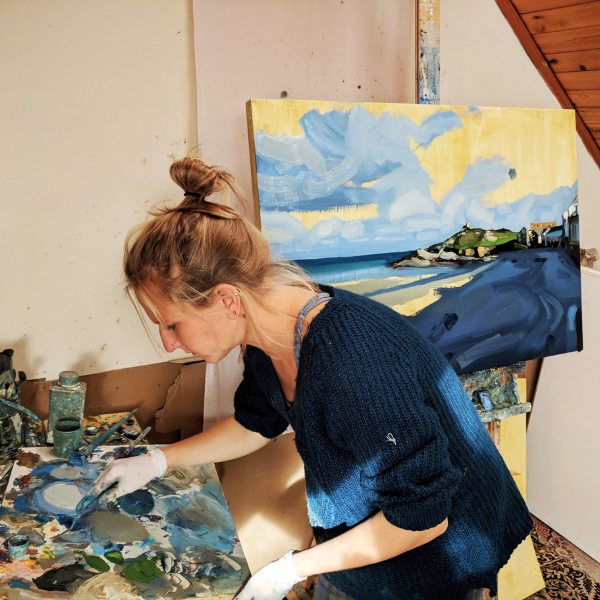
It is a characteristically open way of looking at the world, and one that runs through both Hester’s own practice and her approach to teaching. Rooted in traditional representation, her paintings explore some of the landscape’s least tangible qualities, from light and time to movement and weather.
She is interested in how paint can suggest a fleeting experience without describing every detail, using marks as economically as possible while leaving room for the viewer’s own interpretation.
In 2027, Hester will bring this approach to St Ives School of Painting for the first time, teaching Painting Landscapes in Oils in the Porthmeor Studios.
Life Surrounded by Landscape
Growing up in rural Devon placed Hester in close contact with nature and wildlife from an early age. Although she does not credit the landscape with her decision to become an artist (she thinks that was always going to be the plan anyway) it has profoundly shaped what she chooses to paint.
I paint whatever surrounds me, which is preferably the landscape, it’s where I feel most comfortable.
Hester Berry
Hester studied at Aberystwyth, where a traditional art education developed her interest in landscape while opening up life drawing and portraiture. She later completed an MA in Fine Art at Wimbledon and taught life drawing in Brighton and London, before returning to Devon in 2016, where she now lives and works.
Her attachment to the landscape is not based on a single preferred view, season or type of weather. Although circumstance has led her back to certain locations over the years, she has trained herself to look objectively, resisting the idea that one condition is inherently more paintable than another.
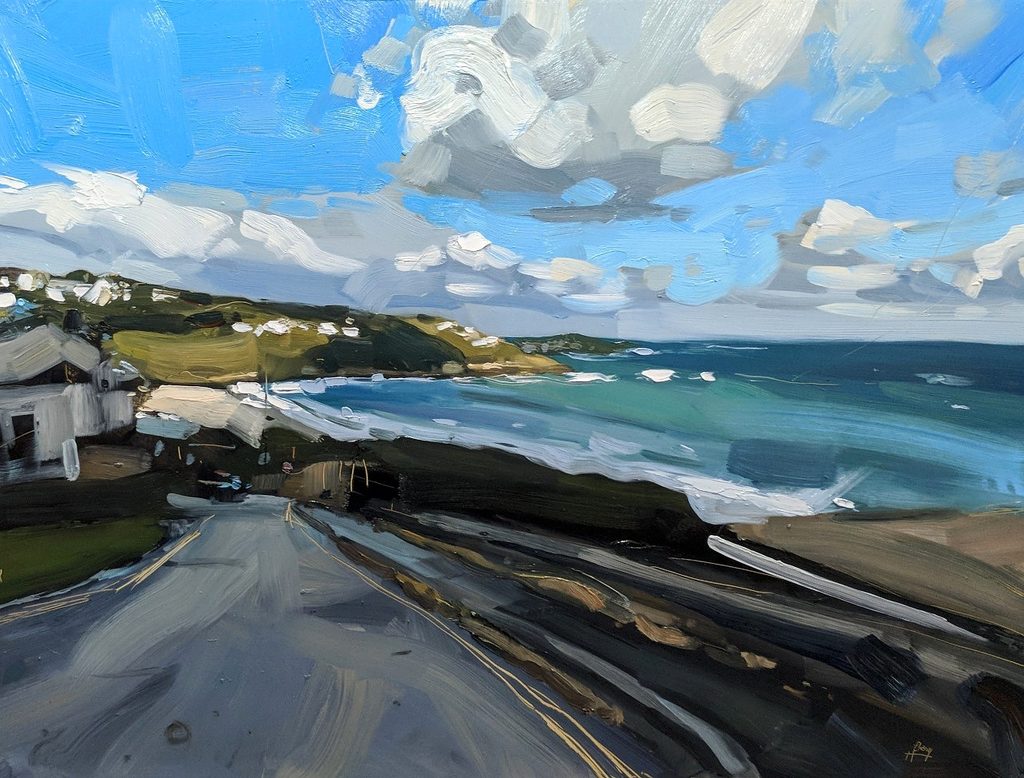
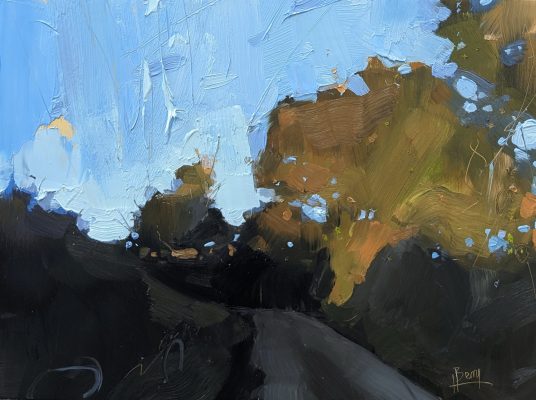
Light is Hester’s favourite subject – and perhaps the most elusive. A painter must translate the enormous spectrum of visible light into the far narrower tonal range between black and white paint. Her response is to stay close to observation, while drawing on methods learned from artists across history and techniques developed through her own experiments.
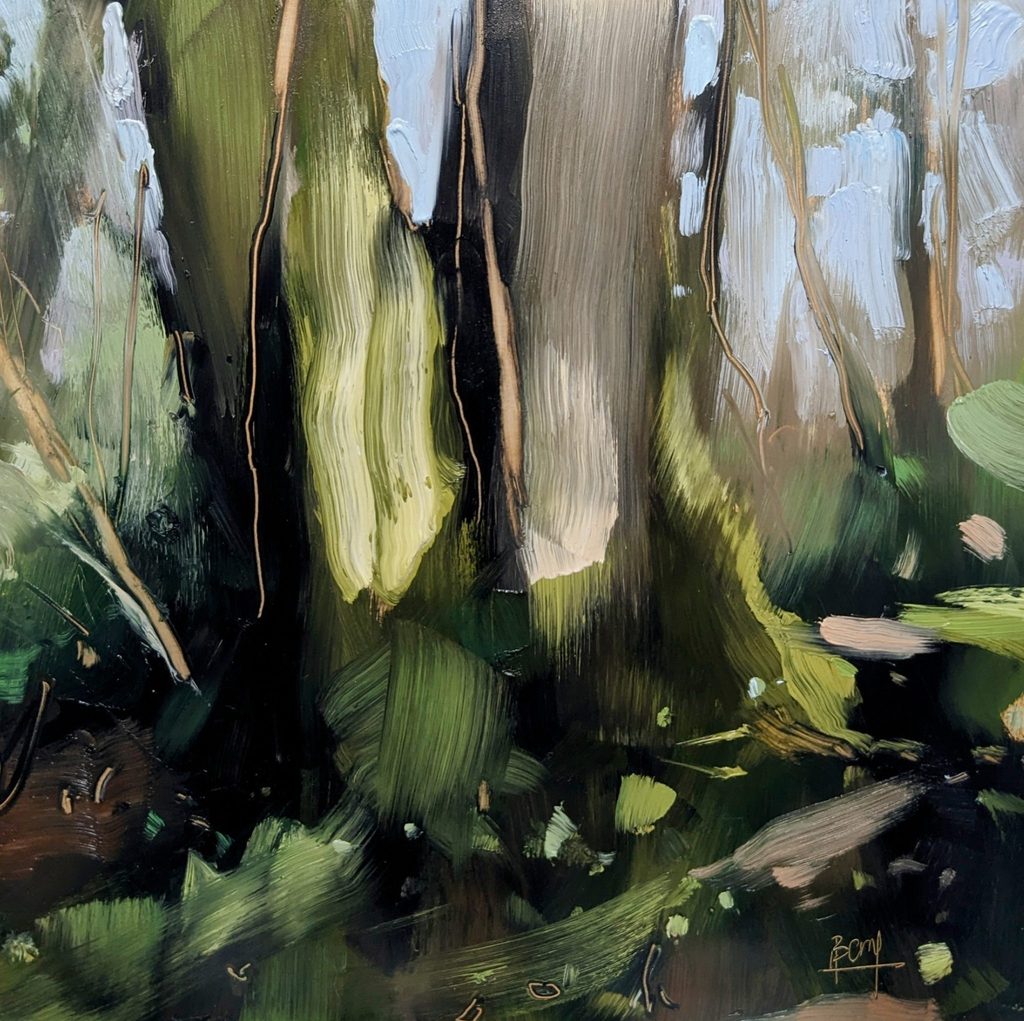
Movement might emerge through dynamic brushwork, a rapidly made study, cartoon-like speed lines or the blur associated with long-exposure photography. Weather can be carried through tone and gesture, but also through the physical character of the paint itself – wet splashes, misty glazes or the abrupt edge of a palette-knife mark.
Light is my favourite subject. I try to stick doggedly to what I observe.
Hester
This directness begins away from the studio. Hester goes out walking and running with a sketchbook and phone camera, usually without a fixed destination or subject in mind. Rather than setting out to find a particular view, she remains alert to whatever catches her attention.
Back in the studio, small photographs provide a colour reference, but not as something to reproduce. Hester deliberately avoids depending on photographic detail. Instead, she works quickly, drawing on habits formed when painting en plein air, where changing conditions make decisiveness a necessity.
Photography may record the appearance of a landscape, but for Hester it cannot hold the whole experience of being there. Drawing outside gives her time to absorb a place and form a connection with her subject, fixing in her memory the qualities a photograph might miss.
For Hester, her sketchbooks are not just preparation for larger paintings. Sketching can be an end in itself, as well as a place to practise, make notes or test an idea.
Sketchbooks are a safe place for practising, thrashing out ideas, making rubbish drawings and making mistakes. I feel a bit lost if I go anywhere without mine.
Hester Berry
This willingness to experiment – and to accept the unpolished work that is part of the process – is central to Hester’s teaching. Rather than asking students to imitate her paintings, she shares practical and technical skills that they can use in their own way. She also introduces artists from the past and present whose work might offer another possibility or a new direction.
Just as importantly, she challenges some of the rigid “rules” that can become barriers to creativity. Her advice is not intended to replace everything a student has learned elsewhere. Instead, she encourages people to notice what is useful, combine ideas from different teachers and reject what does not serve their own work.
For Hester, teaching is not a one-way transfer of knowledge. The people she meets bring experience from beyond painting, and their perspectives often feed back into her practice.
A physicist attending one of her workshops offered a new insight into colour theory. Seasoned travellers have made her reconsider colours in paintings of landscapes she has never visited. Conversations with students have introduced ideas from phenomenology, ecology, neuroscience, politics, history and language.
Teaching also asks her to examine the instinctive parts of her own process. To explain a decision honestly and usefully, she first has to understand why she makes it.
In order to teach honestly and effectively, I need to find ways to articulate things that I do unconsciously. I have had to spend time deeply reflecting on what I do and why I do it.
Hester
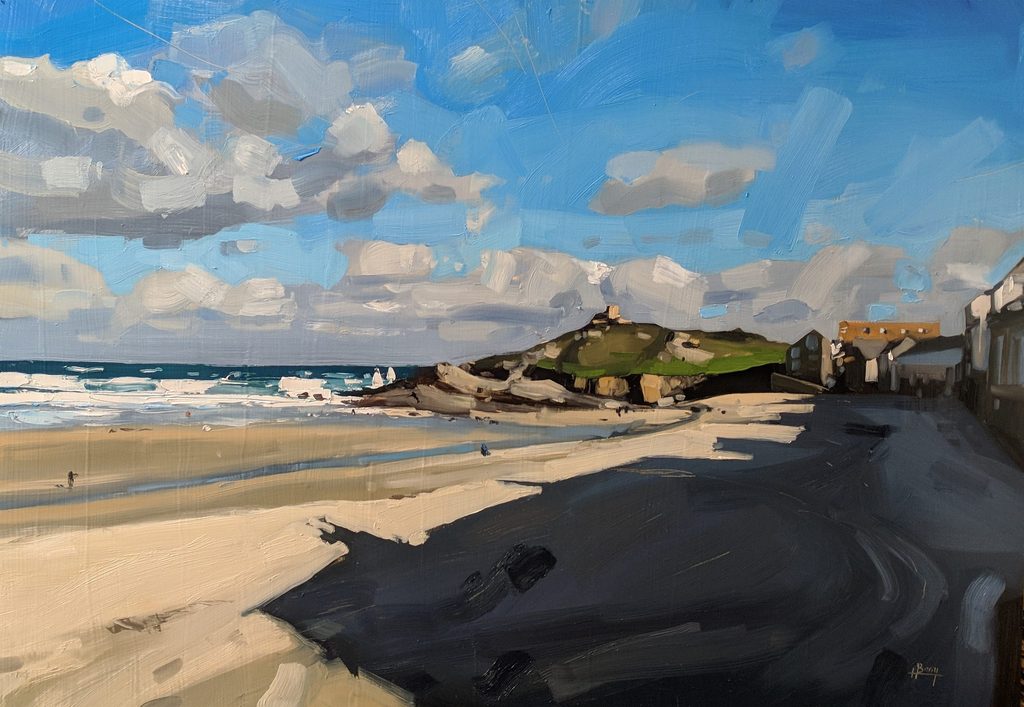
Seeing St Ives from a New Perspective
Hester’s first course at St Ives School of Painting will begin outside the studio, weather permitting, with a short walk and time spent sketching in the landscape. Students will consider what makes a place visually interesting and how its essential information might be caught through quick drawings, notes and observation.
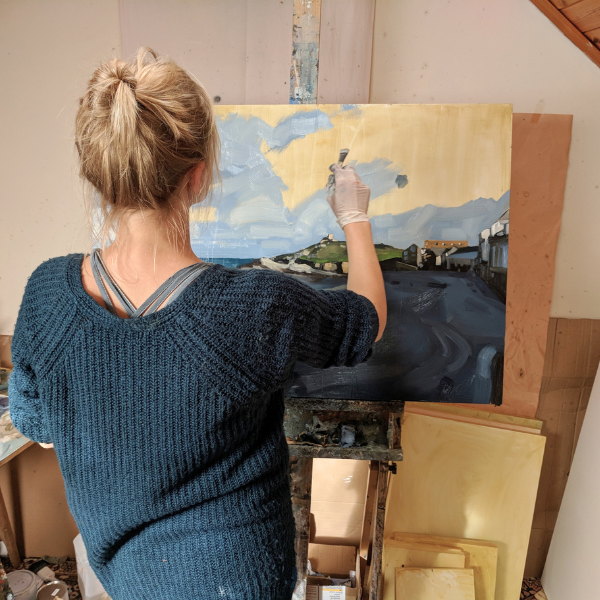
Returning to the Porthmeor Studios, they will develop those references into oil paintings on board. Demonstrations, discussion and individual guidance will explore tone, colour, composition and expressive mark-making, alongside the practical challenges of working wet-on-wet, simplifying a subject, loosening up and deciding when a painting is complete.
The aim is not to arrive at a room of paintings that look like Hester’s. It is to give each student useful tools, greater confidence in their decisions and the freedom to develop a way of painting that feels like their own.
For Hester, the chance to teach and paint at Porthmeor holds particular meaning.
I’m so excited to be teaching and painting in such an art-historically important place. I have always loved the heritage of St Ives, and to be more directly artistically involved here has always been an ambition of mine.
Aside from the painterly lineage, it is such a beautiful part of the world. I love any excuse to paint the Cornish coast.
Hester on St Ives
Quickfire with Hester Berry
What is always playing in your studio?
Quiet while I’m painting, but audiobooks and scientific podcasts as soon as I stop the actual creativity. As soon as I turn my brain off and wash my brushes, I notice the silence.
What is the best advice you have received?
“Paint what you see, not what you think you see” – from my grandpa when I was about four.
Which artist would you most like to share a studio with for a day?
Bernie Krause.
Hester Berry teaches Painting Landscapes in Oils at St Ives School of Painting from 5–7 February and 9–11 July 2027. The three-day course is suitable for all levels, from complete beginners to professional painters.
2/10/2026
Share on
Related Stories
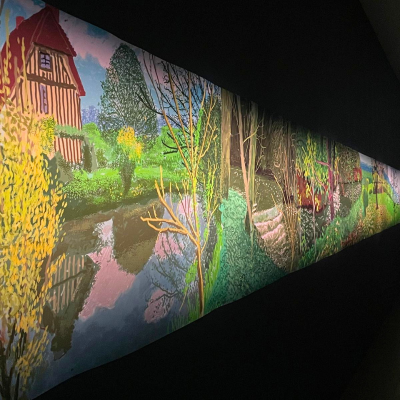
Remembering David Hockney: A Life of Looking
Following the passing of David Hockney, and as we approach what would have been his 89th birthday, we are taking a moment to reflect on the extraordinary legacy of one of Britain’s most influential artists. Born in Bradford in 1937, Hockney’s career spanned more than seven decades, moving through drawing, painting, printmaking, photography, stage design...
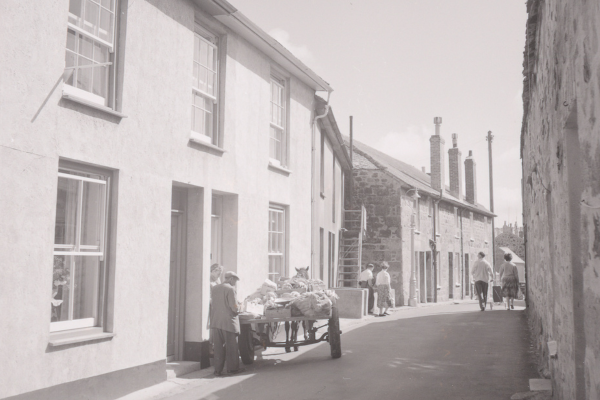
'Images of Downlong - 1880s-to the present day'
We are pleased to share an exclusive talk and Q&A with Janet Axten and a panel of local artists, including Hilary Jean Gibson, artist tutor at St Ives School of Painting, as they discuss why comparatively few artists have chosen to paint Downlong, one of the most historic parts of St Ives. ‘Images of Downlong...
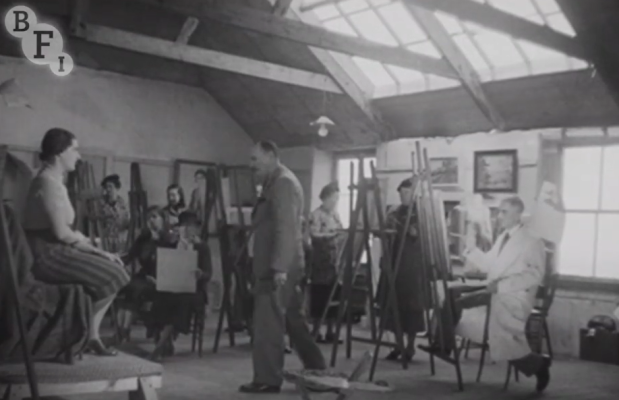
A Glimpse Inside St Ives School of Painting in 1948
Historic footage of our founder Leonard Fuller offers a rare window into the early years of St Ives School of Painting – and reveals how much of its creative spirit remains familiar today. Another World, a short film preserved by the BFI National Archive, takes viewers through the streets, harbour and artistic community of post-war...