How to Develop Your Unique Artistic Style
At times, we can all feel isolated and stuck within our creative boundaries, or within our art practices. Artists spend so much time alone, in their homes or studios, trying to create fresh work, but without the motivation or critical eye of supportive peers. Read more on how to develop your unique artistic style.
One important step on your journey to developing your creative voice is to pause and ask yourself; why am I making art?
Step away from worrying about improving your painting technique, or finding out how to make a living as an artist. The first most critical and exciting step is to find and develop your unique artistic style – so you can become the artist you want to be.
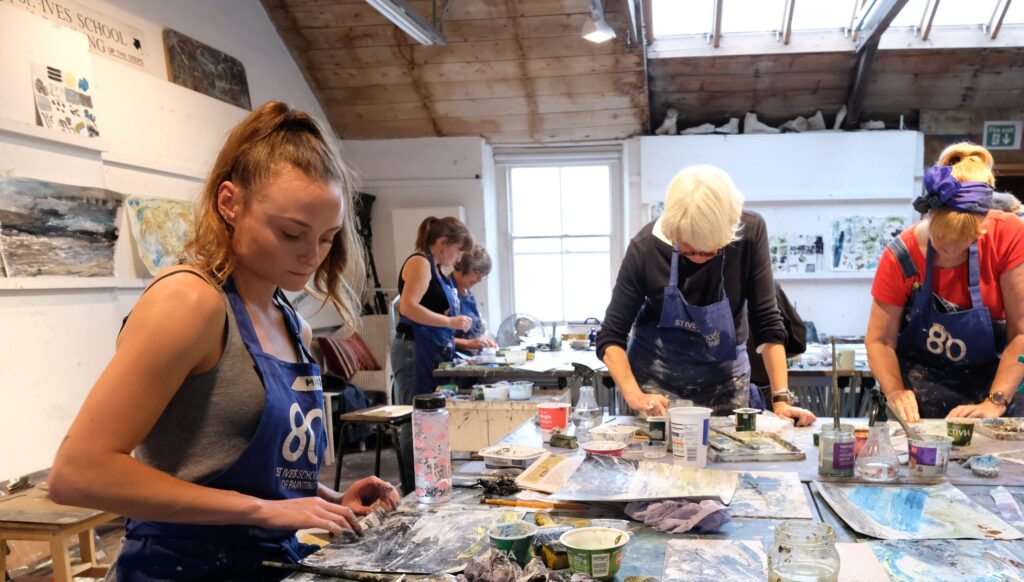
Becoming the artist you want to be
Our yearlong self-discovery course, Porthmeor Programme, now in its tenth year, is a unique opportunity to find and develop your own creative voice over the course of 10 months. Making is at the heart of it.
We combine professional guidance and support with 1-1 tutorials from a lead artist, and practical making workshops led by guest artists. The lead artist gets to know you and your work helping you identify what kind of art you want to make and why. The practical sessions are an opportunity to explore different techniques, experiment and build up a body of work.
I feel more confident in my ideas and approaching work in a freer, more experimental way. I’m able to push through when the going gets touch. I spend less time worrying and more time painting. This programme is a real tonic for artists, the playful approach and the serious are well balanced. It’s great to have surprises and learn something new. I have felt nurtured and challenged throughout.
Jill Holland
What steps will I take?
Throughout the programme, alongside your 1-1 tutorials, you will explore five key themes through practical making workshops. These themes are based around ways of reflective, discussing and critiquing your practice or work, so you can be more rounded in your approach to making art.
The key themes include:
- Encouraging risk and experimentation.
- Exploring personal narratives and stories.
- Responding to places, personal spaces and connections.
- Refining and removing to discover the essence.
- Translation and interpretation.
The process will take you on a journey over the year with the primary purpose of expanding your personal practice. Running through the programme is the development of your critical voice through personal projects, one to ones and group crits. Developing confidence in translation and interpretation is also a ‘creative muscle’ worked on constantly over the course of the year.
How can I find out more?
Applications are now open for our 2027 Porthmeor Programme.
You can find out more by visiting the link below:
9/1/2025
Share on
Related Stories
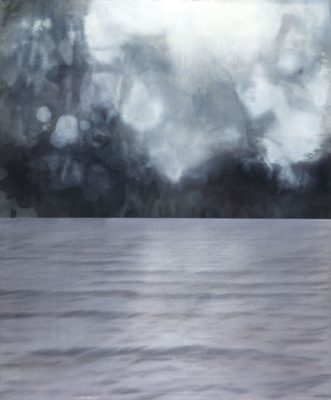
How to Paint a Landscape
As seen in… Landscape painting from artists’ perspective Words by Katie Avis-Riordan Three landscape artists, who also teach at St Ives School of Painting, reveal their top tips on how to paint a landscape painting for beginners. Find out how to paint landscapes using the recommended materials and techniques; and discover how to get inspired by...
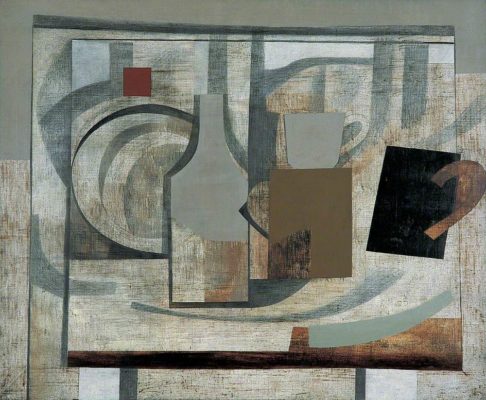
Artists & Illustrators: The Art of Keeping it Simple
As seen in… Artists and two of tutors Liz Luckwell and Marion Taylor share their insights to achieving modernist minimalism in a modern time frame. Harness the powerful abstract potential of the still life, inspired by modernist icons William Scott and Ben Nicholson. Though still resolutely abstract, these 1940s paintings had a domestic quality to...
The Art of Regular Creativity
Somewhere along the way, making art can start to feel complicated. Life gets busy. Energy gets stretched. Expectations creep in. And the thing that once felt freeing slowly turns into something we keep meaning to get back to. “I’ll make time when things calm down.”“I’ll start again when I feel inspired.”“I don’t want to make...